On Plagiarism, AI and Centaurs
Exploring the history of Owlbear Rodeo and how AI affects our future

Ever since I was a kid I’ve loved making games. In my primary school I remember we had computer classes, other kids loved them because with a little help from a portable double desktop app they could pretend to do work while secretly playing Elasto Mania the entire class. For me though I loved those classes because the school computers had a licence to Macromedia Flash. I spent so much time drawing, animating and eventually scripting in Flash. When we had to do a fourth grade assignment on your favourite dinosaur I built a 2D side scroller where you played a plesiosaur dodging fish. Looking back logically it doesn’t make sense a giant dinosaur would be dodging fish instead of just eating them but for me back then it wasn’t about the concept it was about the process. I had no idea what I was doing but following some guides I found using AltaVista I was able to get started. At some point though the guide stops and you’re left on your own. For a lot of people that’s where they might stop but for me that’s then the obsession began.
As I got older I continued tinkering with projects, Adobe bought Flash in 2005 and integrated it with their suite but with the refusal from Apple to allow Flash to run on the newly introduced iPhone it started dying. However at this time there was a shift in the games/animation industry. Autodesk and Epic Games started offering free versions of their software for students. So not only could I continue making games but I could do it using the same software that a lot of my favourite games were made with. At this same time video streaming was starting to take off and with this another core building block of my career started with Harvard releasing their CS50 class online for free. These three things were pivotal to my high school years. Even if I was attending a poorly funded public school from a small Australian suburb I could still learn programming from a world class teacher. I could build my 3D models in Maya without paying the inconceivable $3,000 licence and I could learn Unreal Engine 3 without the impossibility of an enterprise contract. These three things taught me how amazing free education and free software can be.
As I was finishing high school Unreal Engine 4 came out and out of the gate I was obsessed. I had worked all summer at a local pizza place so I could afford to buy an Oculus Rift DK1 and with the release of UE4 I finally had a way to combine the two coolest things at the time; next generation gaming and virtual reality. The engine was so new so there wasn’t a lot of education around but I was there every day tinkering with it. Eventually I started releasing tutorials and guides for free online and one day someone at Epic Games noticed. They put me in touch with a publisher and I ended up writing a book on how to make VR games using Unreal Engine. As a university student it was an amazing experience, the book did well enough that I could continue buying new VR headsets as they came out and it even got picked up by some other higher education institutes. It never happened but I always got a tickle out of imagining me taking a class the next year and part of the curriculum was reading my own book.
A Funny Story
Because of this work I got approached by a few big names in the tech/software world to help them with their VR ambitions but I was still just some kid from Australia. I fell into that weird middle ground where they wanted me to work for them but not enough to go through the hassle of the US visa system. Oh well, I finished my degree and got a job with a small local firm that would allow me to continue doing what I loved, building little apps and games with Unreal Engine. I wasn’t working on the next big hit game or building some small part of a giant machine at a big tech firm, I was small time but the work was rewarding and in the end I cared more about the work than some big title.
When the pandemic hit I wanted to continue playing my weekly D&D game with my friends. Since I had already built a little local app to run my games in person I spent a week converting it to run online and then ran the first game with Owlbear Rodeo. It went terribly by the way, there were so many bugs with the networking that the whole thing fell over. I spent another week fixing bugs and then I posted it to Reddit as I thought it was neat. People seemed to really like it, it didn’t set the world on fire, it wasn’t the next big thing but we started building a small community of people who really liked the site. From the start I put the things that shaped me into everything we did. The product was free because those free versions of Unreal/Maya were so pivotal to my youth. I spent so long making video tutorials because I knew how important free education is both for a product and in general.
Early on there were so many unknowns, it was clearly an unfinished product but just like the dinosaur game from the fourth grade with a broad horizon of problems and an infinite solution space I became obsessed. For the last six years that’s how it’s been, find a problem, come up with a solution and when that doesn’t work try again and again and again. Eventually we came out with a paid tier but we made sure that it was still accessible as possible. No big features behind a paywall was our mantra. After we started making some money we could finally pay for better servers and we even hired an employee. To this day it’s just the three of us, I build the product, Nicola (my partner) builds the servers and Andrew does all things community and support. Still small but still it’s about the work.
When generative AI started to take off and the unimaginable scale of the intellectual property theft started to be revealed I was so angry. It didn’t affect me, I wasn’t an artist but through this wonderful TTRPG community I’ve gotten to know so many artists and the work they do is just incredible. Around this time I was reading a webcomic from Cat and Girl about their thoughts on Midjourney which at the time was just sued for stealing images. In the comic they talk about being small time, about making their comics free and about looking back at the hard times that come when you focus on the work and not on profit.
“If you can reach any kind of financial equilibrium, it’s tempting to look back on your time with no money as a funny story. I need it to be a funny story. Because it was hard. At times, so hard.”
I resonated with this piece so much. We’re small time, we try to make things ethically (our dice roller, music app and so much more of Owlbear is open source) and so many times this has been hard. Nicola and I have discussed so many times how things would be easier if we just went and got a job at some big tech place. But at least I wasn’t being exploited, at least my work wasn’t being stolen.
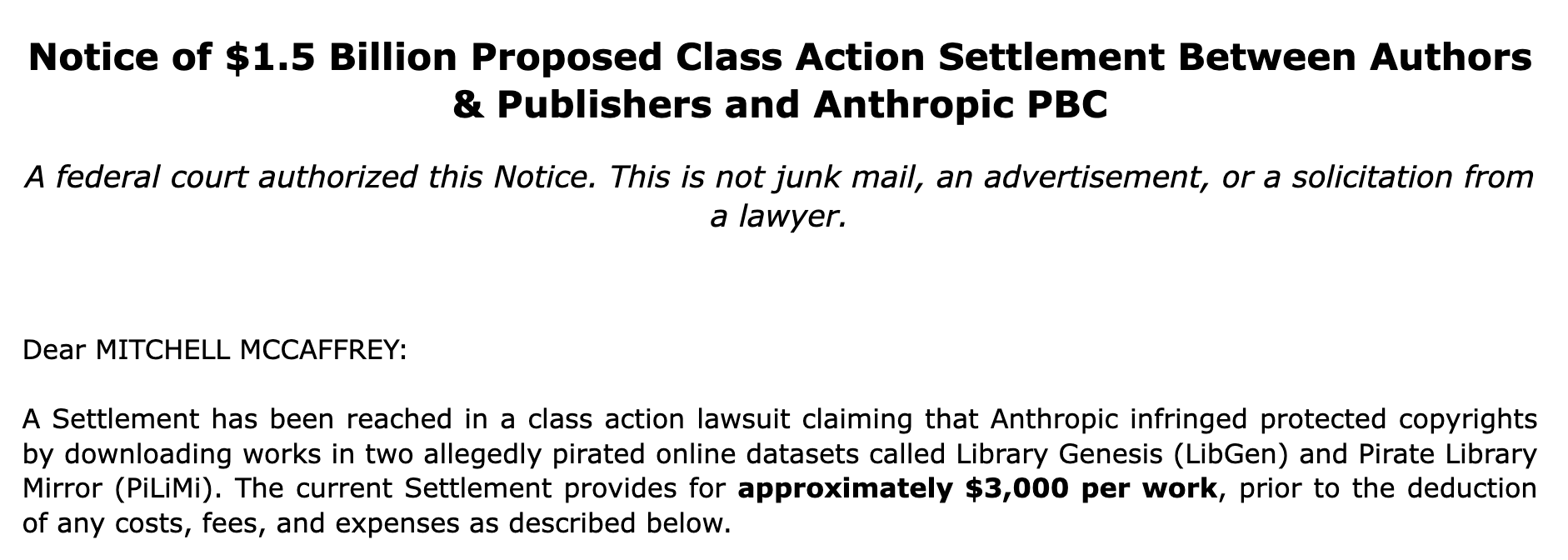
Oh I guess that didn’t last long.
Plagiarism
So yeah it turns out the book I spent a year researching and writing is in the training data for Anthropic’s models. For Cat and Girl there is a specific sadistic nature of stealing a work that someone offers on the internet for free, training an AI model on it, then charging users to use that model. For these AI companies though it doesn’t matter whether it may technically be allowed by the licence of the work, they’ll steal it anyway.
I never saw myself as an author and didn’t really make much from the book and as such Anthropic stealing my book didn’t affect me financially. In the end I wrote a technical book that was tied to a version of Unreal Engine that has been superseded now so an AI model being able to regurgitate my work won’t mean a drop in it’s almost non-existent sales. Even with this in mind I get angry thinking that my work means nothing to these companies.
The YouTube channel hbomberguy made a great video on plagiarism within YouTube creators. In it he talks about how when these people look at the work of others since it’s not their work it has no value, so there’s nothing wrong with stealing it.
“This is on whole how business people see creativity. They don’t respect it. It doesn’t matter. It’s beneath them. So they can take it and say it’s theirs if they want.”
To me this rings true with these AI companies, they fill them up with a mix of researchers and business people, flood them with unholy amounts of investment money and if they crush entire industries of creatives in the process well it was the sacrifice needed for the birth of digital God.
But again I’m not in a creative industry so it doesn’t really affect me.
As an aside I’ve been working on and off on one specific feature of Owlbear Rodeo for the entire six years of its existence. Making sure maps are aligned to the grid so that things like rulers work, it’s something easy to explain but actually designing a tool to do it perfectly requires so much thought. It took me those six years to perfect it so to see Roll20 the biggest VTT copy my work three months after we released it, it made my blood boil. I keep telling myself that this thing happens in software all the time but to announce the feature in a blog post with this line “I designed the new flow to feel more intuitive and guide GMs through every step in the process” no you didn’t you stole my work.
The Owlbear Rodeo alignment tool (left) (source 1, source 2). The Roll20 alignment tool (right) (source 1, source 2)
As an aside within an aside, when I first showed our new alignment tools some people from our community said it looked a lot like the Draw Steel Codex VTT. I hadn’t seen much about that VTT so I went and looked and they have a similar but different feeling process. In their VTT you click to put down points and by putting down three points you can align your map. I think this is a great case for showing how different people can solve the same problem. Our method involves the magnifying glass, the realtime feedback and the distinct stepper for the Offset, Size and Refine steps. When Roll20 takes these ideas and simply changes the names of the steps to Anchor, Scale and Fine Tune I think this is a let me take a look at your homework situation if I’ve ever seen one.
Centaurs
This year I’ve experienced some of the hardest burnout in my entire time building Owlbear Rodeo. We’ve released the new alignment tools as well as Forecast, our new feature to automatically fog maps for you (look for that coming out of beta soon). But in reality those features aren’t actually what I’ve been working on the most. I’ve been spending most of my time building some things that I believe are truly next generational. It’s some of the most technical work I’ve ever done. It’s work that you can only do when you’ve devoted your entire self to something for six years. It’s work that fills me with so much joy. At least it used to.
Even if AI is terrible at creative pursuits, producing truly soulless slop, it is a great productivity tool. Vibe coding, agentic engineering, autonomous loops, the great frontier where coding at the speed of thought is possible. Except the machine can code way faster than I can think let alone understand.
Author Corey Doctorow describes this process as being a reverse centaur. A product like autocomplete automates some of the labor away but ultimately the human is in control of when to use it. It turns you into a centaur, human brain, tireless body. However if you’re in the software engineering field AI has been sold as a technology that can 500x your productivity. The only way to do this is for the human to stop making the decisions. For the AI to drive the thought and the human is just there to review code and make sure things get merged into the end product successfully. This is the reverse centaur, machine head, human body.
When looking around the software developer ecosystem so many people will tell you how great AI is. They’ll share their progress, show off their new apps and tell you about their new workflows that have stopped producing slop. With this I started to put pressure on myself. Look at all these people building things in no time at all. I need to go faster, if I don’t speed up Owlbear will be left behind. I made myself into a reverse centaur and I was miserable. Suddenly these things really did affect me.
“When labor drives automation, it’s in service to quality. When capital drives automation, it’s in service to throughput”
Corey Doctorow mentions this on the Weekly Show when talking about reverse centaurs. I felt this directly in my thinking. I was so worried about throughput, about the vibe coded competition, about losing everything that I’ve worked so hard for over the last six years. But in reality Owlbear Rodeo has always been about quality. It’s been about doing less but doing it well. If we take this quote as commutative then perhaps by focusing on quality we’ll also be able to help the labor and possibly stave off the reverse centaurs.
Looking Forward
At the end of this (way too long) post I wish I could give a nugget of insight, a path forward, a solution to all these problems. In truth I’m not sure I have the answers. As the software industry pushes more and more into automation I don’t think I’ll follow them. For artists I’m not sure what will be best for you, I can only hope that the people will always seek out the soul in the art they look for, I know I will.
For Owlbear Rodeo we’ve still got some amazing things in the works. At the core we still want to offer a kick ass product with a generous free tier, amazing tutorials and an obsession with craft and quality. After this though I think I want to add that we also want to celebrate humanity. People and the things they build are pretty great and if there’s something we can do to help elevate that I think we should.